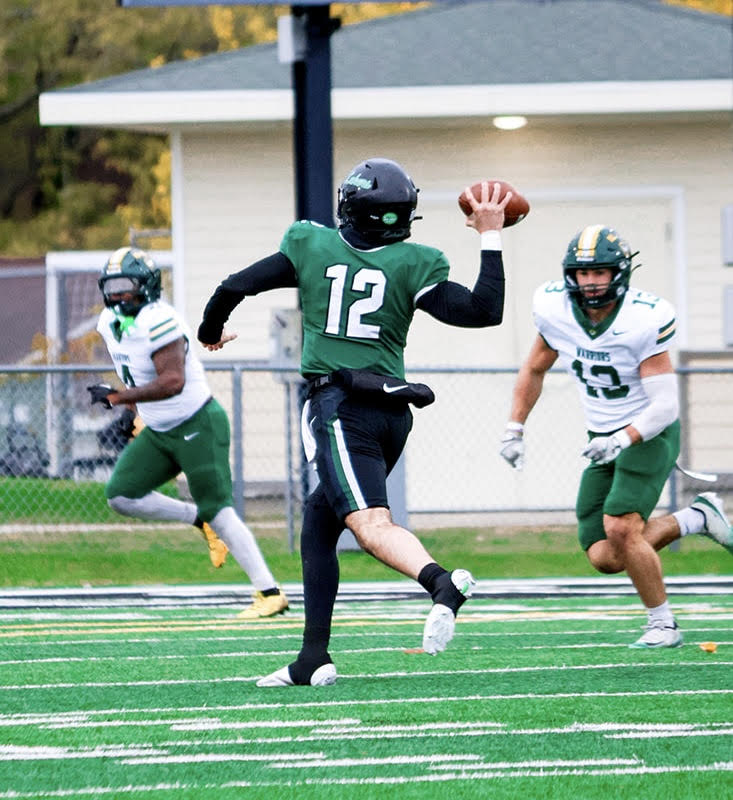
There is a particular kind of athlete whose story does not begin with attention. No early coronation. No immediate certainty that the spotlight will one day belong to him. Instead, there is waiting. There is watching. There is the slow accumulation of habits that do not yet look like headlines.
For Tony Chahino, that wait was not passive. It was formative.
Before he became one of the most productive quarterbacks in Geneva football history and before he began making his mark at Roosevelt University, Chahino was learning the game from the edges of recognition. He contributed where he could, played where he was needed, and kept building quietly toward an opportunity that had not yet arrived.
“Some athletes arrive with hype. Others arrive with habits. Tony Chahino’s story belongs to the second category.”
That distinction matters. It says something about temperament. It says something about patience. And in a sport that asks as much of a quarterback’s mind as it does of his arm, it says something about readiness long before the public can see it.
The Work Before the Breakout
Football fans tend to remember the season when everything changes. The breakout year. The highlight throws. The box scores that suddenly look too large to ignore. But the truth is that those moments are rarely spontaneous. They are usually the visible reward for years of repetition, observation, and delayed opportunity.
That was true for Chahino at Geneva. He did not step into the quarterback role as a finished product. He stepped into it having already spent years building toward it, learning how to read situations, how to stay composed, and how to prepare without the guarantee that preparation would be seen immediately.
By the time his senior season arrived, he was no longer simply waiting for the role. He was prepared to inhabit it.
And when he did, the results were emphatic.
A Senior Season That Changed the Conversation
Once Geneva placed the offense in his hands, Chahino did not merely manage the moment. He expanded it. His senior season became the kind of campaign that forces people to reconsider what they thought they knew. More than 3,600 passing yards. Nearly 50 touchdown passes. An offense that moved with confidence and intent.
Yet even those numbers, impressive as they are, only tell part of the story. The deeper significance lies in what they represented: not a lucky stretch, not a system-only success, but the visible proof of a quarterback whose process had finally found its stage.
In the IHSA Class 6A state championship game, Chahino delivered the kind of performance that cements a season in memory. He threw for more than 300 yards and four touchdowns, carrying Geneva with the kind of poise that reveals itself only when pressure has somewhere to go.
“The most impressive part of his rise wasn’t just the production. It was the calm behind it.”
Even in defeat, the performance clarified something important: Tony Chahino was not a one-season curiosity. He was a quarterback whose work had matured into command.
Roosevelt and the Next Stage
College football is where many high school narratives are tested. The transition exposes what was sustainable and what was situational. For quarterbacks especially, the jump is as much psychological as physical. Speed changes. Windows narrow. Expectations sharpen.
At Roosevelt University, Chahino did not vanish into the background. He stepped forward again.
In his first collegiate start, he threw for over 300 yards and three touchdowns. Later, he posted a 366-yard performance that set a Roosevelt school record. These are not empty milestones. They matter because they suggest continuity. The discipline that defined his senior year in Geneva did not remain there. It traveled.
That may be the clearest sign yet of who he is becoming: not simply an athlete with a strong season behind him, but one with a game and mindset capable of continuing to grow under new demands.
More Than a Stat Line
It is easy to describe Chahino in football terms alone. Quarterback. Leader. Producer. But the athletes who resonate beyond their position usually carry something else with them — a sense of credibility rooted in the way they work, the way they prepare, and the way they move through pressure.
That is what makes his story especially compelling for a platform like Fox Valley Review. He represents a kind of athlete who feels increasingly important in this moment: one whose identity is not manufactured by hype, but earned through steady development, local roots, and a trajectory that still feels upward.
In an era shaped by visibility, that combination matters. It gives communities someone to recognize, younger athletes someone to learn from, and partners someone they can align with without feeling like they are borrowing credibility they have not earned.
The Story Still Being Written
There is always a temptation to treat athletes as finished once they have produced enough to get noticed. But the more interesting stories are often the ones still unfolding. Chahino’s is one of them.
He did not arrive early. He arrived ready.
That may sound like a subtle distinction, but in sports — and in life — it is often the difference between attention and staying power. One is granted by timing. The other is earned by preparation.
Tony Chahino’s story is compelling precisely because it reminds us that some athletes are built long before the world decides to look in their direction. And when it finally does, the best among them are already prepared for the moment.